


How to Choose a Reliable Solid Wood and Engineered Wood Flooring Manufacturer for Global Projects
Leave a message
For an importer, flooring distributor, private-label brand, or commercial project team, choosing a wood flooring supplier is not only a matter of comparing price per square meter. The right manufacturing partner must deliver consistent grading, stable dimensions, repeatable colors, complete technical documents, and dependable shipment planning across every order.
This is particularly important when sourcing solid wood flooring, engineered wood flooring, herringbone flooring, chevron flooring, or custom parquet. A product may look attractive in a catalogue, but its commercial value depends on how reliably the factory can reproduce the specification at production scale.
For international buyers, the evaluation should cover five areas: manufacturing experience, material and process control, quality assurance, compliance documentation, and supply-chain capability. This article explains what to look for and how TEYA Flooring supports wholesale, custom, and project-based procurement.
Why the Manufacturer Matters in a Flooring Procurement Project
Product consistency is a commercial requirement
A flooring order is normally sold through a specification: wood species, grade, dimensions, structure, moisture content, surface treatment, joint profile, packaging, and installation method. If the factory changes the veneer, color, coating, or tolerance between batches, the buyer may face installation problems, customer complaints, or costly replacement claims.
A qualified flooring manufacturer should therefore be able to translate a product brief into controlled production parameters. For example, buyers may need European oak or American walnut, a particular grade, a brushed or handscraped surface, a UV lacquer or natural oil finish, and a specific herringbone or parquet pattern. The supplier should confirm which parameters are standard, which are custom, and which require a new sample or approval before mass production.
Technical support reduces installation and after-sales risk
Professional flooring procurement also involves technical decisions. Solid boards and engineered boards respond differently to humidity and temperature. Project teams may require glue-down, floating, secret nail, or other installation options. They may also need guidance on moisture content, underfloor heating, carton packing, palletization, and site storage.
A factory that provides pre-sales technical guidance and installation or maintenance information helps its customers reduce avoidable site issues. For a distributor or brand owner, this support can be as important as the initial product quotation.
What to Evaluate in a Solid and Engineered Wood Flooring Factory
Manufacturing experience and process control
Start by checking how long the manufacturing team has worked in the flooring industry and whether the factory controls the key stages in-house. TEYA's published company information states that its wider flooring manufacturing experience dates back to 1984, while Huzhou Teya Floor Co., Ltd. was established in 2017. The company supplies solid wood flooring, engineered flooring, and parquet products for international markets.
TEYA also describes a production platform equipped for flooring processing, including HOMAG moulding equipment, Taiwan-made sanding equipment, automatic cold presses, drying kilns, floor slicers, and a UV finishing line. The company identifies Treffert and PPG Germany as lacquer suppliers and Woca, Osmo, and Saicos as oil or wood-wax brands used in its finishing programs. For buyers, the value of this information is not the brand list alone; it is the ability to discuss a repeatable process from timber preparation and drying through profiling, sanding, surface finishing, inspection, and packing.
The company's product information also lists an annual production capability of approximately 600,000 square meters for its wood flooring factory. Capacity should always be matched to the specific product, grade, season, and order schedule, but a published production figure gives buyers a useful starting point for supply planning.
Material structure, moisture management, and finishing
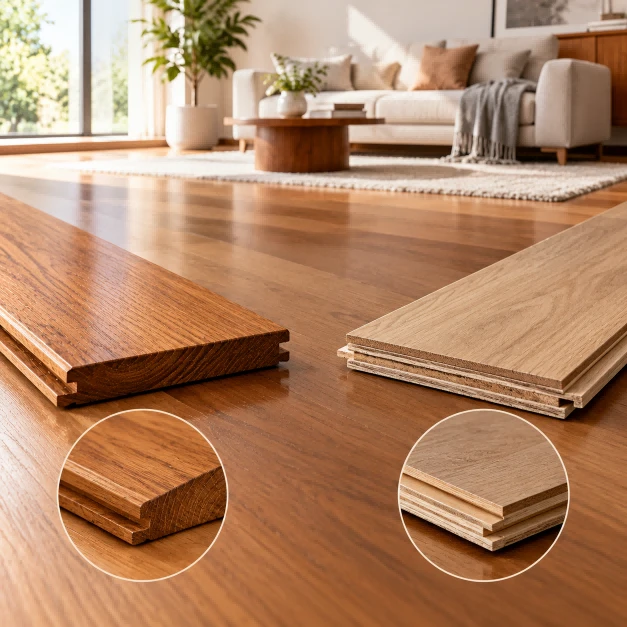
When comparing an engineered wood flooring supplier, ask for a clear cross-section of the product. TEYA offers three-layer and multi-layer structures, and selected product specifications describe birch plywood cores, oak wear layers, tongue-and-groove joints, and moisture content targets such as 6–9% or 8–12%, depending on the product.
These details matter because the structure determines stability, installation compatibility, and the suitable end market. A procurement team should confirm:
Wood species, source statement, and veneer grade
Solid or engineered construction and the thickness of each layer
Moisture content at the time of packing
Plank dimensions and allowable tolerances
Tongue-and-groove or click-joint design
Surface options, including brushed, smoked, carbonized, limed, handscraped, stained, UV lacquered, oiled, or unfinished
Compatibility with the intended installation method and project conditions
For custom flooring, the approval process should include a physical sample, color reference, surface reference, and written specification. This creates a practical benchmark for production inspection and future repeat orders.
Quality inspection and technical documentation
A reliable wood flooring factory should explain how it inspects raw materials, semi-finished boards, finished surfaces, dimensions, moisture, joints, packaging, and loading. TEYA states that production processes are strictly controlled and that products undergo safety testing. Product pages also publish technical parameters and, for selected products, test information based on EN and ASTM methods.
Buyers should request the documents relevant to their market and product, such as:
Product technical data sheet and approved specification
Moisture and dimensional inspection records
Surface and coating information
Formaldehyde or emissions documentation where applicable
Fire, wear, slip, or other performance reports where required
Packing list, commercial invoice, and shipping documents
Current certificates and scope of certification
The precise documentation depends on the destination country and the intended use. A professional supplier should identify the documents available for the actual SKU rather than making a general compliance claim for every product.
TEYA Flooring: From Product Development to Export Delivery
A factory platform for solid wood, engineered wood, and parquet
TEYA's product range covers solid hardwood flooring, engineered wood flooring, wood plank flooring, herringbone, chevron, and designer parquet. The catalogue includes species such as European oak, American walnut, teak, and other wood options, with product formats for residential, hospitality, commercial, and project applications.
This breadth is useful for buyers who need more than one flooring category from a single supplier. A distributor can develop a coordinated collection, while a project team can compare solid and engineered constructions under one technical communication process.
Custom manufacturing for brands, distributors, and projects
Custom flooring may involve more than changing a color. TEYA states that it accepts customization of size, veneer type, structure, wood species, grading, brushing, smoking, staining, refinishing, paint process, and surface finish. Its designer parquet information also describes custom patterns and the possibility of manufacturing under a customer's brand.
For an OEM or private-label program, buyers should send a brief that includes the target market, annual or initial quantity, preferred species, dimensions, grade, surface, packaging, logo requirements, installation system, and required compliance documents. TEYA can then assess feasibility, prepare a sample, and provide a quotation based on the confirmed specification.
Export packaging and supply-chain coordination
The factory's published information describes export packaging with cartons and pallets, container loading references, and international delivery support. TEYA states that its products are exported to markets including the United States, the United Kingdom, and Japan, and that its team participates in exhibitions in Germany, the United States, and Dubai.
For a buyer, export readiness should be verified at quotation stage. Confirm the agreed Incoterm, destination port, packing method, loading quantity, production lead time, shipping documents, and responsibility for any destination-specific requirements. TEYA lists EXW, FOB, CFR, CIF, and DDP as available delivery terms, subject to order details and negotiation.
Certifications and Compliance: What Buyers Should Request
Certification requirements differ by country, product construction, project type, and claim being made. TEYA's published company and product information references ISO9000/ISO9001, ISO14001, CE, FSC, and SGS-related certification or testing information. Selected product pages also reference EN and ASTM test reports.
Because certificates have a defined scope and validity period, buyers should request the current document, issuing body, covered factory or product, expiry date, and applicable test standard before placing a purchase order. The same approach should be used for low-emission, environmental, fire-performance, and formaldehyde-related claims.
This document-based approach protects both sides: the buyer receives evidence suitable for internal approval and market compliance, while the manufacturer can quote against the actual technical and legal requirements of the project.
How to Start a Flooring Wholesale or Custom Program
A productive RFQ should include enough information for the factory to quote accurately. At minimum, provide:
Product category: solid, engineered, herringbone, chevron, or parquet
Wood species, grade, and preferred color
Construction, thickness, width, length, and joint
Surface treatment and coating or oil preference
Estimated quantity and target order frequency
Destination country and port
Packaging, private-label, and pallet requirements
Required certifications, tests, and compliance documents
Sample reference, drawing, image, or existing product specification
After receiving the brief, request a physical sample and a written quotation that separates product, packaging, tooling or development, freight, and documentation costs where applicable. Confirm the final approved sample before mass production.

Request A Sample Or RFQ From TEYA Flooring
If you are sourcing solid wood flooring, engineered wood flooring, wholesale parquet, or a custom flooring collection, send TEYA your product brief and target quantity. Include your preferred wood species, dimensions, finish, destination port, packaging needs, and compliance requirements so the factory can respond with a more accurate proposal.
Tell us what you need to buy, how much you plan to order, and where the flooring will be sold or installed. TEYA's team can then recommend a suitable construction, prepare a sample, and develop a supply plan for your market.


